
What You’re Really Looking At: A Local Hiker’s View of the Mountains Around Los Angeles
Every time there’s a brush fire in the hills around Los Angeles, we get the same worried question from guests: “Is the Hollywood Sign okay? Is my tour still happening?”
Almost always the answer is yes, and the reason comes down to geography that the headlines never explain. Los Angeles isn’t ringed by one set of hills. The San Fernando Valley alone is framed by four separate mountain ranges, and a fire in one of them can be miles away from the landmark you’re picturing.
I’ve hiked these hills for more than forty years. Let me show you what I mean, starting with one photograph.
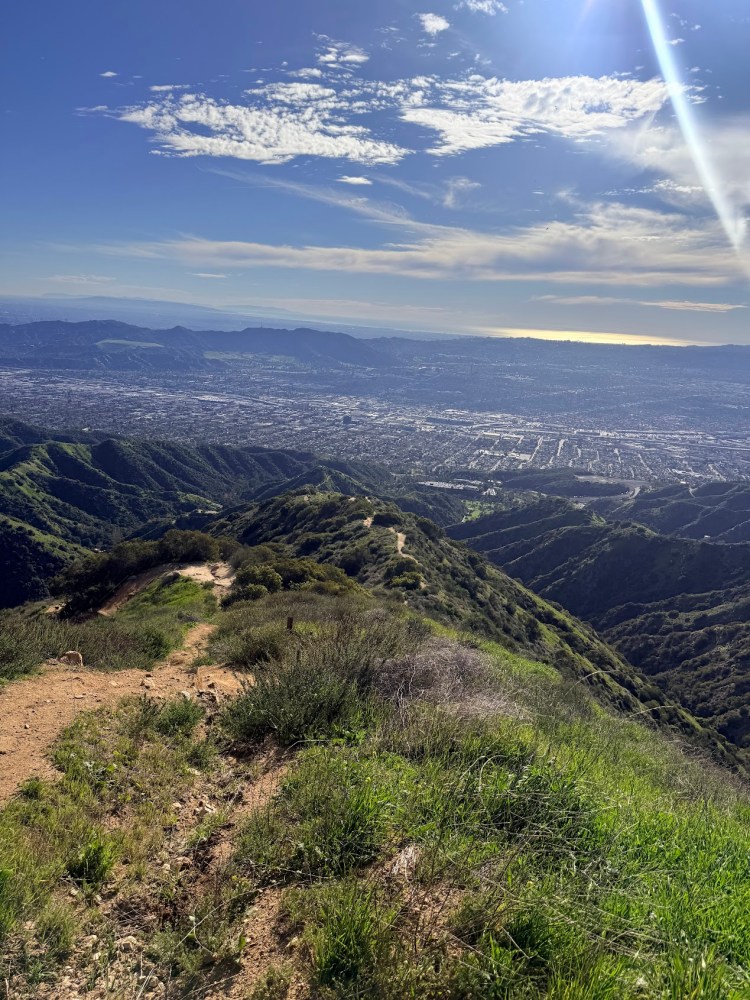
The view southwest from the Verdugo Mountains. Below is Burbank; the far ridge is the Santa Monica Mountains, with Mount Lee and the Hollywood Sign on the other side.
One photo, two mountain ranges
I took this shot from a ridge in the Verdugo Mountains, on the eastern edge of the San Fernando Valley, looking southwest.
The city spread out below is Burbank. The ridgeline on the far side of the valley is a completely different range: the Santa Monica Mountains, the ones locals call the Hollywood Hills. Look closely at that ridge and you’ll find a tower. That’s Mount Lee, and the Hollywood Sign sits on the far side of it, facing away from this view.
Keep looking past the ridge and you’ll see the Pacific Ocean. On the left, through the haze, is Santa Catalina Island. The high ground above it is the Palos Verdes Peninsula.
So in this single frame you’re seeing two separate mountain ranges with the entire valley between them, plus the ocean and two distant landmarks. That’s Los Angeles: a city built in and around its mountains.
The four ranges around the San Fernando Valley
The Verdugo Mountains, the eastern edge. The Verdugos rise on the eastern side of the valley, above Burbank and Glendale. They’re steep, rugged and mostly undeveloped, which makes them a favorite for serious hikers and, in dry season, a frequent spot for brush fires. This is where the Walnut Fire burned in August 2026. The Hollywood Sign is nowhere near here.
The Santa Susana Mountains, the northern edge. To the north, the Santa Susanas separate the San Fernando Valley from the Santa Clarita Valley beyond.
The Simi Hills, the western edge. On the western side, the Simi Hills roll toward Simi Valley and the Ventura County line.
The Santa Monica Mountains, the southern wall and home of the Hollywood Sign. This is the range visitors care about most. The Santa Monica Mountains form the southern wall of the valley and run all the way to the coast. The stretch above Hollywood is what locals call the Hollywood Hills, and the Hollywood Sign sits here, on Mount Lee, in Griffith Park. This is a completely different range from the Verdugos on the eastern side.
Why this matters when you see a fire on the news
When a fire breaks out “above Burbank,” it’s in the Verdugo Mountains on the eastern edge of the valley. The Hollywood Sign is in the Santa Monica Mountains on the southern wall, with the whole valley in between. Two separate ranges, often miles apart.
So a Burbank fire and the Hollywood Sign are rarely the same story, even when a headline makes them sound close. Knowing which range is which can be the difference between canceling a trip and enjoying it.
The mountains are why the movies came
There’s a reason the film business settled here and never left. Beyond the sunshine and the cheap early land, Los Angeles offered something almost no other city could: variety, all within a short drive. Within an hour of a studio lot, a crew could film a desert, a beach, a pine forest, a canyon and a city skyline.
The Santa Monica Mountains are a big part of that. They’re one of the few ranges in the country that run east to west rather than north to south, they’re the only relatively undeveloped range in the United States that runs straight through a major metropolitan area, and they hold the largest urban national park in the country. That’s a lot of wild country tucked into a city of millions.
We know this because we walk it
Guideline Tours has been showing visitors Los Angeles since 1988. We don’t just drive these hills, we hike them. That firsthand knowledge is exactly what lets us time our Hollywood Sign viewpoint for the best light, find the roads the big coaches can’t take, and tell you honestly whether a distant plume of smoke has anything to do with your afternoon.
When we say we know this city, we mean we’ve walked it.
Planning a visit? Our Best of Hollywood Tour Package covers the Walk of Fame, Beverly Hills, celebrity homes and a premium Hollywood Sign viewpoint in one relaxed afternoon.